

Somewhere between the “dress for the job you want” advice and the ten-slide carousels promising a blazer will change your life, we started treating confidence like a finishing touch. Something you spritz on last, like perfume, right before you walk out the door. I want to argue the opposite, because confidence and personal style absolutely belong together… just not in the order everybody keeps selling you. Confidence isn’t the accessory. It’s the foundation garment; the thing underneath everything that decides how the rest of it sits.
And let’s be clear: As a corporate girlie with 15+ years in the game, I love fashion. A beautifully tailored blazer, the perfect heel, an unexpected silhouette… those things absolutely matter when commanding a room. Personal style is one of the most powerful forms of self-expression we have. But even the best look can only introduce you. Confidence is what brings the whole look to life.
How to Build the Base
Great style is built in the closet, but confidence is built everywhere else. The wardrobe should reflect the work, not replace it. Here’s how:
- Dress from identity, not insecurity. Wear what fits who you already are, not what you’re hoping the clothes will trick people into believing. If you can’t wear it with ease, it isn’t your piece yet.
- Real receipts. Gravitas is mostly track record; the quiet knowledge that you’ve done hard things and can do them again. Every project you finish is a deposit nobody can repossess.
- Practice composure under fire. Grace when things get messy reads as leadership; staying level under pressure is the single biggest thing that makes people take you seriously.
- Know your thing cold. Being able to go six questions deep in your domain signals authority. Depth is the flex.
- Let the style evolve. Give yourself permission to change your look as you grow. A wardrobe that never shifts usually belongs to a woman who’s a little afraid to.
The Internet Keeps Telling You Fashion Makes You Confident. The Science Is Shakier Than That.
You’ve probably seen the claim, maybe in a Forbes explainer: what you wear “directly changes your thoughts, feelings, and behavior.” The technical name for it is enclothed cognition, coined in a 2012 study by Hajo Adam and Adam Galinsky. It caught fire fast; the paper has been cited more than 600 times and covered in over 160 news outlets, which is exactly why it now gets repeated like settled fact.
Here’s the part that the carousels leave out. The headline experiment, the one where wearing a lab coat supposedly sharpened focus, did not hold up. A high-powered, preregistered replication couldn’t reproduce the effect, and Galinsky himself acknowledged the replication was done competently and that the results cast real doubt on his original finding. The authors still defend the broad idea that clothing can influence how we think and feel; notice the retreat, though, because “can influence,” said softly, is a very different promise than “will make you confident.”
So the lift is real-ish. It’s also small, inconsistent, and nobody’s sense of self should be built on it. Which is the whole reason I’m writing this.
Why the Order Is Confidence First, Then Fashion
There are two different things we lazily lump together as “confidence,” and this entire argument lives in the gap between them.
Confidence is the Lift.
Yes. But it’s a temporary bump; the blazer that makes you stand a little taller at 9 a.m., the heels that change how you walk across the lobby trying to grab that man’s attention. It’s real, and it’s useful. It’s also like the weather. It moves with the outfit, the room, the lighting, and the compliment you did or didn’t get on the elevator.
Confidence is the Base.
This one is durable. It’s the self that’s still standing when the blazer’s getting dry cleaned, when the airline loses your good luggage, when you gained the fifteen or lost the contract. Fashion can hand you the lift; fashion cannot manufacture the base.
And the order isn’t just philosophy, especially for ambitious women. If your confidence is sourced from what you wear, then it’s sourced from what you can access, and access is fragile. Your budget shifts. Your body changes with a season, a pregnancy, a year of your life. That trend that made you feel untouchable ages out by spring.
Build your self-worth on the wardrobe and you’re always one closet, one price tag, one size away from empty. For women still building, still leveling up, still walking into rooms where they get read before they open their mouths, that is a dangerous place to keep your foundation.
How to Tell Confidence From Costume
Nothing demonstrates this better than a blazer, so I want to camp here for a minute. The blazer is coded as the confidence garment, the executive-presence uniform. Half the time, though, it isn’t confidence at all. It’s armor.
Appearance Is Only 5% of Executive Presence
When workplace economist Sylvia Ann Hewlett studied what actually reads as executive presence, she had senior executives weigh its three pillars, and the results are wildly uneven.
- Gravitas, how you carry yourself, took 67 percent.
- Communication took 28.
- Appearance, the entire visual package with clothes included, came in at a humbling 5 percent, and even that mostly counts as a first impression.
Sit with that math for a second. The blazer is the 5. Everything people actually respond to is the 67 you built long before you got dressed.
The Blazer Reveals; It Doesn’t Grant
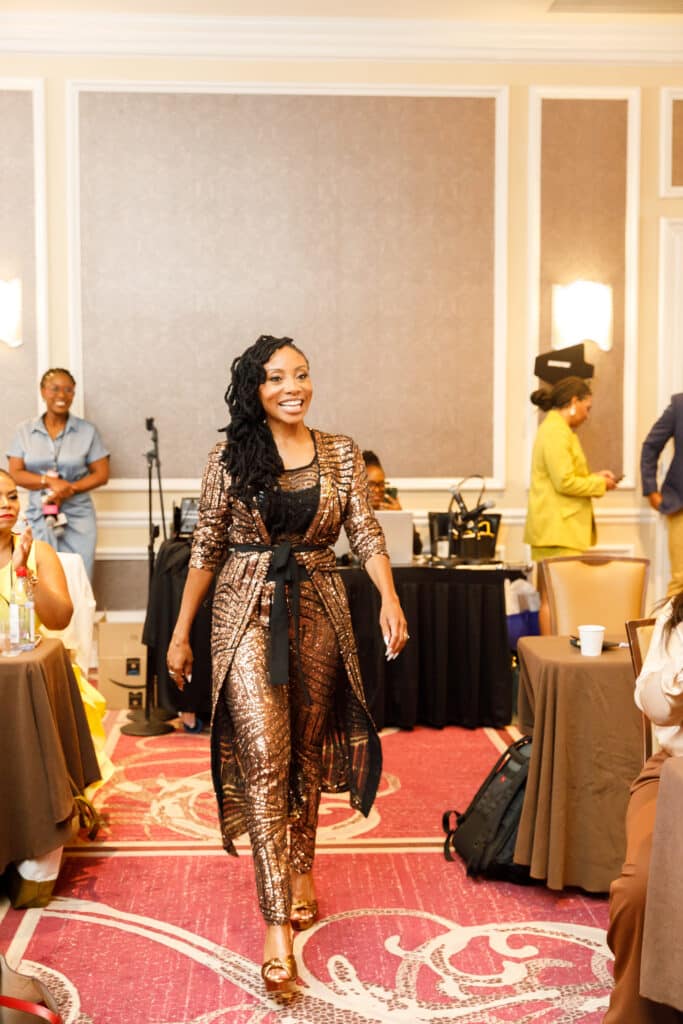
So the jacket doesn’t hand you presence. It points at whether the presence is already there. Same blazer, two completely different readings: on a woman whose base is solid, it looks authored, like an extension of her. On a woman using it to borrow authority she doesn’t feel yet, it looks like a costume doing the talking for her. People clock the difference even when they can’t put words to it.
The Tell Is Ease, Not Posture
The giveaway is physical, and it’s subtle. A structured blazer is cut to hang clean on a body at ease; the shoulder line holds, the lapels lie flat, the fabric keeps the shape it was built for. Tension wrecks that line, and tension shows up two ways. One is the collapse, the slouch that bunches the back and gaps the collar. The other is the over-correction, bolt upright with the shoulders braced, gripping the thing like a shield. Both are armor, and both fight the garment. A confident body is neither rigid nor slumped; it’s easy, and the blazer lies on it completely unbothered. Same jacket, and it fits completely different, because the body underneath changed, not the tailoring.
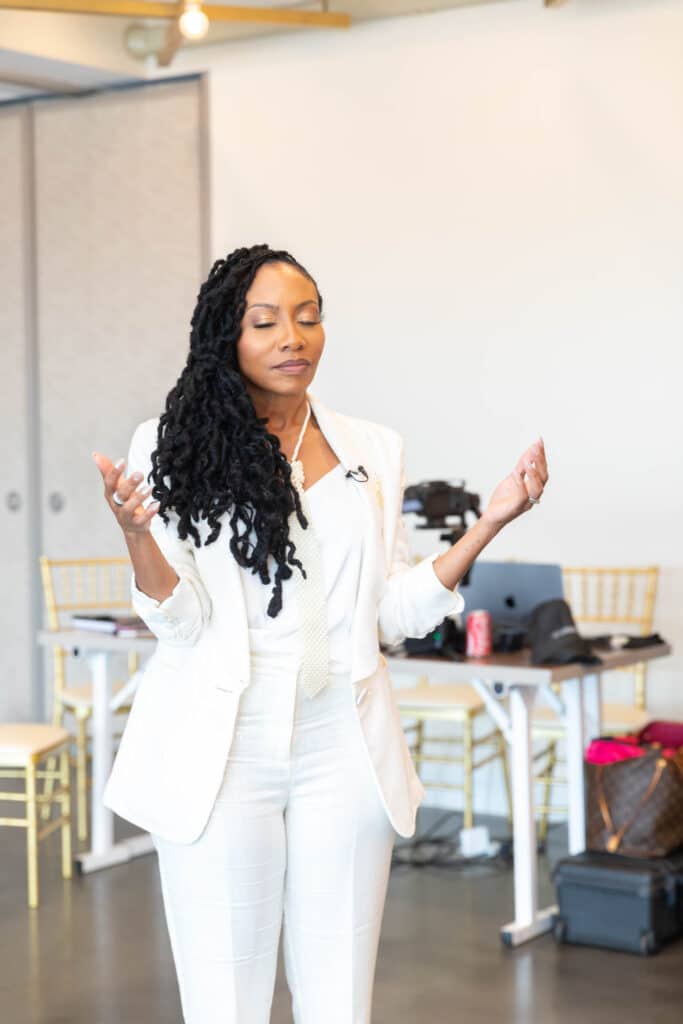
Asya Watkins is a great example. Founder of Women of Project Management, author of The Little Black Book of Project Management Advice, keynote speaker, a woman who has spent years stacking actual receipts. When she shows up in a blazer, it isn’t the blazer doing the work; it’s the aura the blazer is pointing at. She wears it authored, because the 67 percent was handled long before the outfit ever got picked. Put that same jacket on someone hollow underneath and it only makes the hollow louder. The garment always tells the truth about the base.
What Confidence-First Actually Does for Your Style
When your worth isn’t riding on the outfit, personal style stops being a security blanket and starts being a playground.
Insecurity freezes style. You cling to the one silhouette that “works,” the safe uniform, the thing that hides what you’re self-conscious about, and you repeat it like a hostage negotiation. Listen, I’m guilty of wearing a uniform and it has everything to do with “all black is just more slimming and elegant without even trying”. However…
Security lets style move. You take the risk, try the color, outgrow a look on purpose, and let your aesthetic evolve as you evolve, because none of your identity is staked on getting it perfect. Confidence isn’t dependent on fashion. Confidence is the engine that keeps your fashion alive and changing.
Career Woman Aesthetic: Mastering Confidence and Style in the Workplace – The Nerd Bae
Sources
- Adam, H., & Galinsky, A. D. (2012). Enclothed Cognition. Journal of Experimental Social Psychology, 48(4), 918–925. https://www.semanticscholar.org/paper/Enclothed-cognition-Adam-Galinsky/08421f26cfefe22121f48cddd678f93bcdaa26b5
- Burns et al. replication and Adam & Galinsky’s response, “Reflections on enclothed cognition.” ScienceDirect. https://www.sciencedirect.com/science/article/abs/pii/S0022103118308199
- Horton, C. B., Adam, H., & Galinsky, A. D. (2023). “Evaluating the Evidence for Enclothed Cognition: Z-Curve and Meta-Analyses.” PubMed. https://pubmed.ncbi.nlm.nih.gov/37458322/
- Hewlett, S. A. Executive Presence: The Missing Link Between Merit and Success (three-pillar breakdown: gravitas 67%, communication 28%, appearance 5%, from 268 senior executives surveyed). Summary: https://www.thrivestreetadvisors.com/leadership-library/executive-presence
- Hewlett, S. A. (2024). “The New Rules of Executive Presence.” Harvard Business Review. https://hbr.org/2024/01/the-new-rules-of-executive-presence