

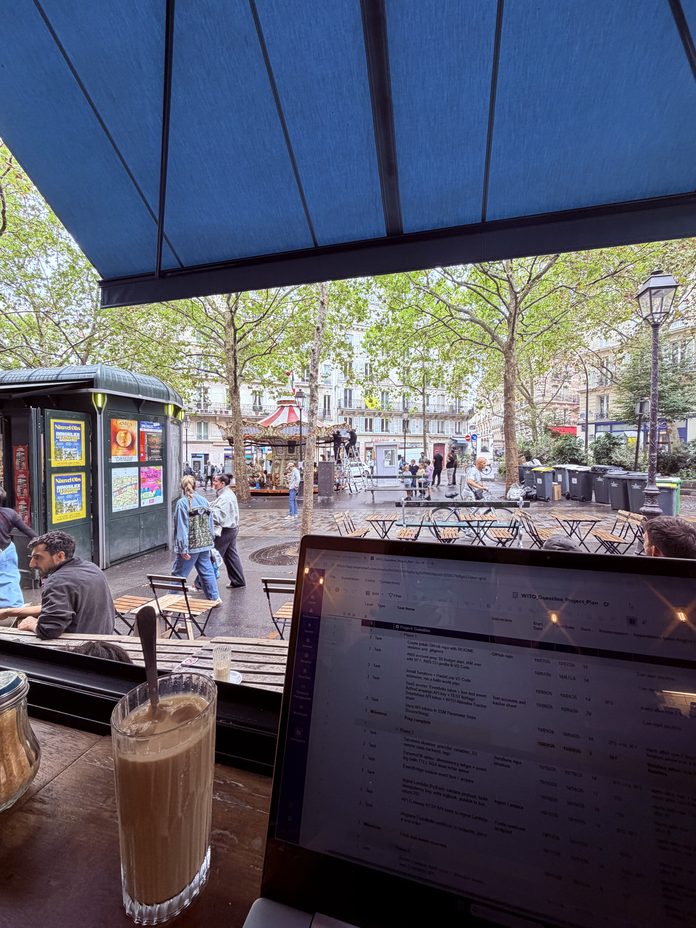
I keep going back to Paris. Four trips now, and every time I land I feel the same quiet click, like a city I barely know somehow remembers me. (If you’re planning your own first trip, I broke down where to stay in Paris neighborhood by neighborhood.)
On my first three visits, I heard all the jokes. People said the metro smelled like pee, the rats were bold, and the trash was everywhere. I nodded politely and genuinely couldn’t relate. I wasn’t naive, and I wasn’t pretending the city was perfect; I was simply too enchanted to register much else. The limestone facades, the café chairs all facing the street, the women in trench coats who look like they woke up dressed, the bookstalls along the Seine… all of it was so loud that a bin bag on the corner never stood a chance.
Romantic places do that to you. When you’re in love with a city, it quietly edits itself for you, and you don’t even notice the cuts.
On trip number four, the edit stopped working. Paris smelled different to me this time, and once I noticed, I couldn’t stop noticing.
This post is about the moment my rose-colored glasses came off, what I learned about Paris waste management once I went looking, and why seeing the mess made me want to understand the city better instead of loving it less.
What I Noticed, and How Paris Waste Management Actually Works
After one very specific experience (I’m getting there, I promise), my senses switched from “vacation mode” to “inspection mode.” Suddenly I was clocking things I had walked past dozens of times:
- Big bags of trash lined up along the curb, waiting for pickup
- Flattened cardboard stacked outside boutiques and cafés
- Rows of bins wheeled out in front of apartment buildings
- A sour, food-forward smell near certain collection corners, especially in the warmer afternoons
- The sheer volume of stuff a dense, beautiful, very lived-in city produces every single day
My first instinct was the lazy one: Paris has a trash problem. Then I did what I always do when something bothers me… I went looking for the system underneath it. What I found is that Paris doesn’t simply have a trash problem. It has a waste management system, and a fairly sophisticated one.
Who does what
Think of it as two layers that hand off to each other:
- Collection (the street level). The City of Paris is responsible for getting waste off the sidewalks. During the 2023 strike, AFP reported that city crews covered about half of the arrondissements, with private contractors handling the rest. The city also collects from some businesses.
- Treatment (everything after the truck). That’s Syctom, the public agency that treats household waste for 81 communes and 5.7 million people, including Paris. In 2025 it processed 2,130,117 tonnes of waste.
The bins
Parisians sort into several streams, according to the city’s sorting guide:
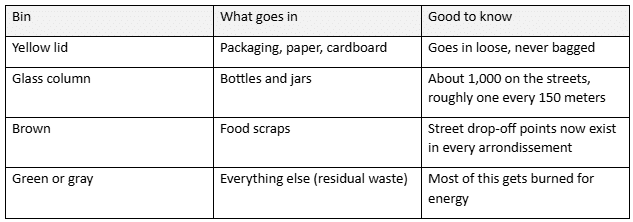
The food scraps piece is new-ish. Since January 1, 2024, French law has required every town to give residents a way to sort food waste, and Paris now promises a drop-off point within three minutes of home. The same city page admits that nearly one in five Paris buildings lacks a yellow or white sorting bin at all.
Where it all ends up
Here’s how Syctom’s 2025 tonnage broke down, per its annual activity report:
- 60.5% went to energy recovery (burned to make heat and electricity)
- 29.3% was recycled or composted
- 10.1% went to landfill
That energy recovery happens at three plants just outside central Paris: Ivry/Paris XIII, Isséane in Issy-les-Moulineaux, and L’Étoile Verte in Saint-Ouen. The heat feeds the region’s district heating networks. L’Étoile Verte alone injects about 1.1 million MWh of heat a year, the equivalent of more than 105,000 homes, including several hospitals.
So when you toss a coffee cup into a green bin in the Marais, there’s a decent chance it ends up helping heat an apartment.
Green isn’t the same as clean
This is where my brain started itching. A city can be environmentally sophisticated at the infrastructure level and still feel unpleasant at street level. Those two things live in different parts of the system. I’m not claiming one causes the other; I’m saying they’re separate problems, and we tend to judge the whole thing by the only part we can smell.
The Movie Theater That Took Off My Rose-Colored Glasses
It was 9 a.m., and I wanted to see Verity. Simple plan. The showing that fit my morning was at UGC Ciné Cité Les Halles, which sits underground inside the Forum des Halles shopping center. In hindsight, “underground” was red flag number one.
Riding the escalator down, I passed a huge sign on the glass: Sous vos pieds se trouve le 1er cinéma du monde. Beneath your feet is the number one cinema in the world. That isn’t just marketing. According to Time Out Paris, it drew about 2.6 million moviegoers in 2025, more than any cinema on the planet. It’s also the only theater in France that opens at 9 a.m., and the film industry watches that first showing like a weather forecast. That explains why the room was packed at 9 a.m..
Here’s how the next fifteen minutes went:
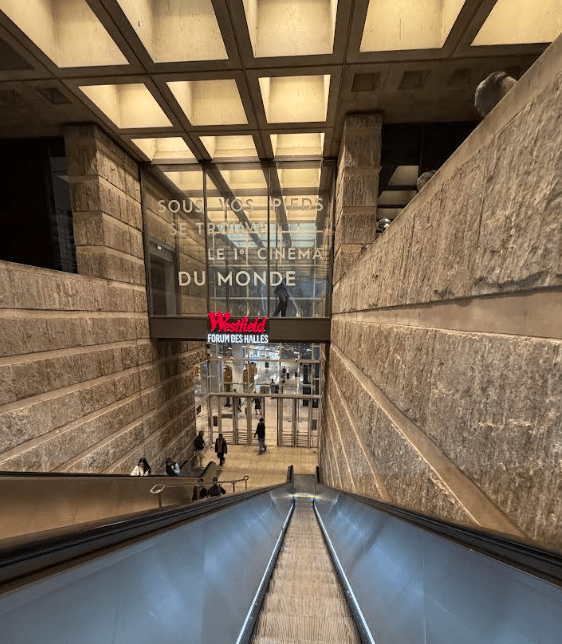
- The descent. The smell got stronger with every level down. I told myself it was just the underground air, and that surely the theater itself would be fine.
- The theater. It was not fine. It was worse. Still, every seat was full and nobody looked bothered, so I sat down and assumed I was being sensitive.
- The previews. I watched them with my jacket pulled over my nose and mouth like a bandit.
- The mistake. When the movie started, I lowered the jacket. I decided I was being dramatic and it couldn’t be that bad.
- The exit. What smelled to me like a sewer hit me so hard I almost threw up. I ran out gasping, and I couldn’t breathe comfortably until I was back above ground.
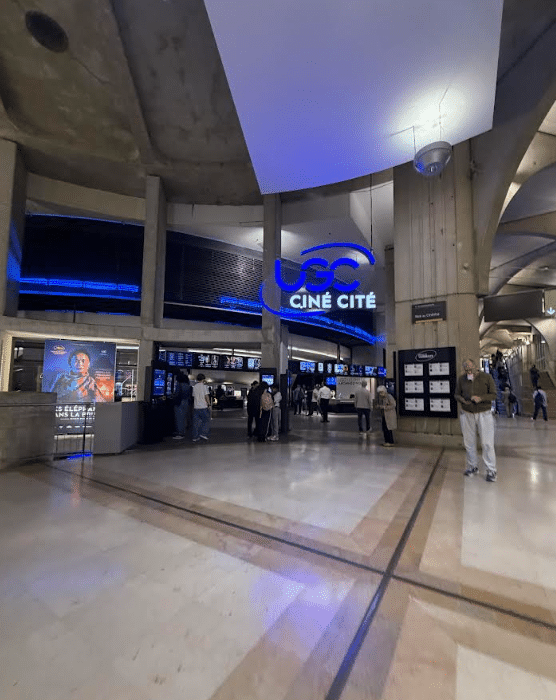
Then I had an ugly cry, right there in the middle of my Paris trip. It sounds ridiculous typed out, but it felt like a betrayal from a city I love so much. I was genuinely devastated.
The smell didn’t stay in the theater, either. For the rest of the day, I kept catching whiffs of something and wondering whether it was actually the city or whether my brain had simply been knocked onto high alert. I started seeing bags and bins I’d never registered before. The whole city looked different through that new lens.
Later, I told my honorary niece (she’s my nieces’ age, a close family friend, and a real Parisian) what happened. Her response was immediate: I had picked the worst possible theater, and I should have asked her first. She recommended a newer one. I appreciated it, but I have no desire to test that theory anytime soon.
To be clear, this was one theater on one morning. I can’t tell you what caused that smell, and I won’t guess. It isn’t evidence that Paris cinemas smell bad, or that Les Halles represents the city. The point of this story is perception: one bad sensory experience changed what I noticed for the rest of the trip.
Why I couldn’t un-smell Paris
I wanted to know why one morning could rewire a whole trip, so I went to the research. Three findings explain a lot.
- Noses adapt to what’s always there. Continued exposure to an odor lowers how strongly we perceive it, a process called olfactory adaptation. In one study summarized by Monell Chemical Senses Center researcher Pamela Dalton, people whose bedrooms were scented with an air freshener for two weeks became markedly less sensitive to that scent, but not to a different control odor (Dalton, Journal of Cosmetic Science). I can’t know what anyone else in that theater was smelling. Still, adaptation is one plausible reason a room full of regulars looked unbothered while I was fighting for my life.
- Expectations change what we smell. In Dalton’s experiments, people told negative things about an odor rated it as more intense and reported more irritation than people given positive information about the exact same odor (same review). After that theater, every corner came with a negative expectation attached.
- Smell is wired straight into emotion and memory. In a small fMRI study of five women, a personally meaningful odor activated the amygdala and hippocampus more than the same memory cued by a picture (Herz et al., 2004, Neuropsychologia). It’s a tiny sample, so I hold it loosely, but it matches a long line of research on why smells feel so emotional and so sticky.

Put together, the theater didn’t put trash on the streets of Paris. It changed my filter. Things that were always there finally made it through.
Where Does “Away” Actually Go?
We say we throw things “away” as if away were a magical void. It’s actually a place, usually several places, connected by trucks, barges, conveyor belts, and a lot of people doing hard jobs before most of us wake up.
The life of a Paris trash bag
- The bin. You sort (or don’t) into yellow, glass, brown, or green.
- The truck. Collection crews pick it up on a set schedule that varies by building and arrondissement.
- The sorting or transfer center. Recyclables get separated, baled, and sold to recyclers. Food scraps head toward composting or biogas.
- The energy recovery plant. Residual waste is burned, and the heat becomes steam for district heating and electricity.
- The leftovers. The ash that remains, called bottom ash, gets treated too; Syctom now ships some of it by barge on the Seine, avoiding roughly 2,800 truck trips a year.
- The last resort. Whatever can’t be recovered, about a tenth of the total in 2025, goes to landfill.
Paris vs. New York: same problem, different playbooks
I always say Paris reminds me of New York. Both are dense, walkable, and full of people living stacked on top of each other, with restaurants on every corner. They’ve just made very different bets about waste.
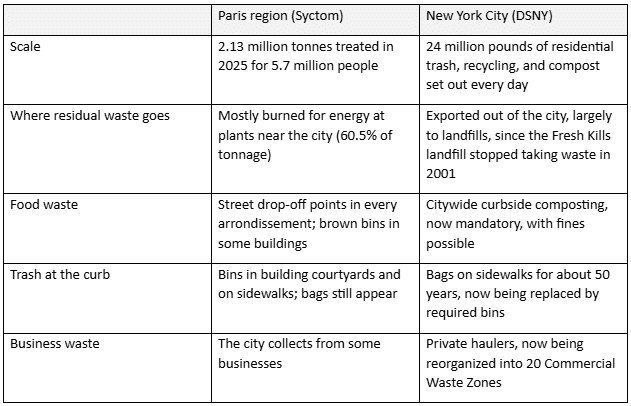
New York’s recent changes are worth a closer look, because they’re aimed squarely at the street-level experience:
- Businesses had to containerize first. Since spring 2024, every business must put trash in a secure bin. DSNY says it has written more than 100,000 summonses since.
- Small residential buildings followed. Starting November 12, 2024, buildings with one to nine units had to use lidded bins, the first residential container rule in more than 50 years. As of June 2026, only the official NYC Bin counts.
- Big buildings are getting “Empire Bins.” In West Harlem, about 1,100 on-street containers now cover more than 80% of apartment units. DSNY calls it the first European-style on-street container program in North America, and Brooklyn’s Community District 2 is next.
- Composting went universal. Under Local Law 89 of 2023, separating food scraps is required, and DSNY reports record tonnage diverted from landfill.
- Commercial hauling is being redrawn. Five of 20 Commercial Waste Zones are fully running, with citywide rollout planned by the end of 2027. Businesses will pay less to haul recycling and compost than trash.
- The early results are visible. DSNY credits the bins with fifteen straight months of declining rat sightings.
The funniest detail for me: New York is openly borrowing Europe’s street-level playbook while it keeps trucking most of its residual waste to faraway landfills. Paris invested heavily in the treatment side, yet the curb is where a visitor like me actually meets the system.
Every city has to put its waste somewhere. Some hide it better, some burn it for heat, and some ship it hundreds of miles away. None of them get a “trash disappears” option.
The Paris Tradeoff
Paris bet big on energy recovery, and there’s real logic behind it. There’s also a real debate.
The case for burning what’s left
France, like the EU, follows a waste hierarchy: prevent waste first, then reuse, then recycle, then recover energy, and landfill only as a last resort. French law explicitly places energy recovery after recycling. So for the stuff that truly can’t be recycled, turning it into heat for apartments and hospitals beats burying it.
The case that Paris leans on it too hard
Critics, including members of the French parliament, have argued that Syctom’s strategy is heavily oriented toward energy recovery when it should be pushing recycling harder. Syctom’s own numbers give that argument weight:
- About 71% of what’s in an average residual bin could have gone to recycling or composting instead of the incinerator, based on Syctom’s 2020 to 2025 sampling (2025 report).
- Roughly 24% of that residual bin is organic waste, like food scraps.
- About half of glass packaging still ends up in the trash rather than the glass column.
- Food scrap collection is growing fast (up 21.3% in 2025) but is still tiny, at about 3.5 kg per person per year.
To its credit, Syctom is moving in that direction. Its new Ivry plant, L’Interval, will burn 350,000 tonnes a year, half the capacity of the plant it replaces. After construction delays, it’s now expected to start before summer 2027. A biomethane plant in Gennevilliers, built to turn 50,000 tonnes of food scraps a year into gas and fertilizer, is also on track for 2027.
The last mile is a different problem
Here’s the distinction that changed how I think about all of this: the treatment system and the street-level collection system are connected, but they aren’t the same problem. Incineration doesn’t make a street smell. What a pedestrian experiences comes from what happens before the truck arrives, and a lot can happen there:
- Waiting time. Waste sits in bins, courtyards, and on curbs between pickups.
- Food scraps. They’re more than 70% water, according to the City of Paris, which is why they break down and smell fast when mixed into regular trash.
- Heat. Warm afternoons speed up everything above.
- Business waste. Restaurants, markets, and shops produce a different volume and mix than apartments.
- Container design. Open bins, overfilled bins, and bags on the ground all leak smell differently.
- Residue. Bins and pavement that hold onto old leaks keep smelling after pickup.
- Density and routing. Narrow streets and heavy traffic make frequent, quick pickups harder.
I’m not saying any one of these explains Paris specifically; I don’t have the data for that. I’m saying a city can have world-class treatment and still need a better last mile.
What the 2023 strike revealed
If you visited Paris in March 2023, you probably saw the extreme version of this. Waste collectors and incinerator workers struck against France’s pension reform, and the three plants serving Paris were blockaded. By mid-March, City Hall estimated about 10,000 tonnes of uncollected trash on the streets. Once the strike lifted, that fell to roughly 650 tonnes within days.
That was a labor dispute, not a design flaw, and it’s not what a typical visit looks like. (If you’re nervous about strikes or safety in general, I covered that in is it safe to travel to Paris.) It did prove something useful, though: the curb is the most fragile point in the entire system. When the handoff breaks, the street is where everyone feels it first.
The back end, by contrast, is surprisingly resilient. When a fire destroyed Syctom’s Paris XVII sorting center in April 2025, the agency rerouted about 1,000 tonnes of weekly recycling to other sites the same evening.
The backend works; the user experience doesn’t
In my day job as a solutions architect, I’ve watched beautifully designed systems fail because nobody designed the moment a human actually touches them. The data flows, the integrations hold, uptime is perfect… and users still hate it because the front end is clunky.
Paris’s waste system felt like that to me. The backend (sorting centers, energy plants, district heating) is genuinely impressive engineering. The front end is the curb, and that’s the only part most residents and visitors ever experience. We judge the whole system by its interface, the same way we judge an app by its login screen.
What Would Actually Make Paris Cleaner?
I don’t have a master plan, and I’d be suspicious of anyone who claimed one after a single trip. What I do have is a list of areas I’d want to explore if I were sitting in a room with the people who run this system.
Fix the curb
- More frequent pickups where volume peaks. High-tourism and restaurant-dense blocks likely need a different rhythm than quiet residential streets.
- Enclosed, better-designed storage. Paris already has its Trilib’ sorting stations on the street. New York’s Empire Bins show how far assigned, lidded, on-street containers can go.
- Smarter timing. New York started cutting the hours bags sit out in October 2022 by changing set-out rules and picking up earlier.
- Cleaning the collection points themselves. New York’s redesigned BetterBin litter baskets have no holes in the bottom eight inches, specifically so they stop leaking garbage juice onto corners.
Get smarter about the data
- Fill-level sensors where they make sense, so trucks go where bins are actually full.
- Predictive routing that accounts for heat, events, markets, and tourist seasons.
- Odor hotspot mapping. Syctom is already recruiting a “nose jury” of trained local volunteers, alongside electronic noses, to monitor its future biomethane plant. Something similar for problem streets seems worth a pilot.
Change what goes in the green bin
- Push food scraps out of the trash. With roughly a quarter of the residual bin being organic waste, this is the lever that serves both goals at once: better recycling and less odor at the curb.
- Get businesses on the same page. Restaurants, buildings, and city crews need shared schedules and standards, the problem New York’s Commercial Waste Zones are trying to solve.
- Keep educating, creatively. Syctom’s 2025 food-waste campaign ran ads in nearly 300 cinema complexes and printed a million baguette sleeves for bakeries. (Ironically, a movie theater is exactly where I’d have seen it.)
Here’s my takeaway. Paris may not need a dramatically greener story. It needs a more operationally intelligent curb, and the two goals overlap more than they compete: every food scrap that leaves the green bin is one less smelly bag waiting on the sidewalk.
Seeing Paris Clearly Is Its Own Kind of Love
Honestly, this whole experience made me sad at first. I didn’t want to become the tourist who lands in one of the most beautiful cities on earth and only sees what’s wrong with it. That person is exhausting, and I’ve rolled my eyes at her plenty.
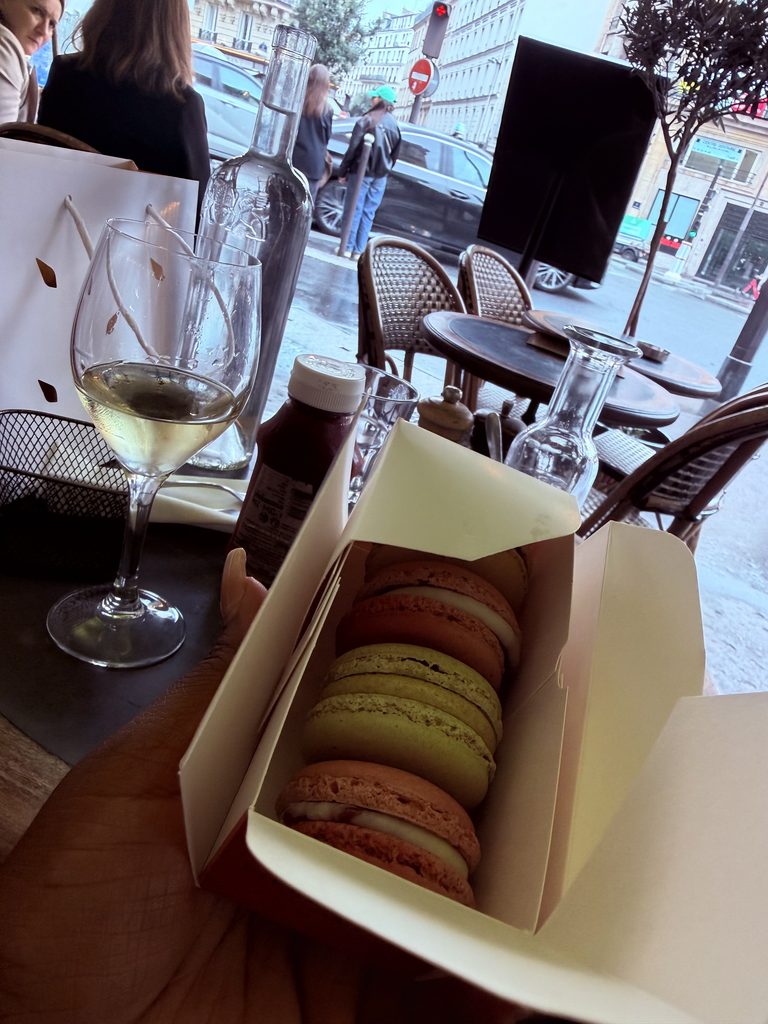
I also don’t want a sterilized Paris. The last thing I’m asking for is an American-style city where everything is hidden, sanitized, and designed to feel frictionless. Part of what I love about Paris is that it feels lived in: laundry on balconies, market crates stacked at dawn, people actually inhabiting the beautiful buildings instead of just photographing them.
So here’s what I want instead:
- Keep the character. The narrow streets, the old buildings, the café culture, and the messiness that comes with real life.
- Upgrade what sits underneath it. Better bins, better timing, better data, and less food rotting in the wrong container.
- Measure success at the curb. A great system should feel great to the person walking past it, not just look great in an annual report.
Seeing the mess didn’t make me love Paris less. Weirdly, it made me want to understand it more. My brain is wired for systems, which is probably why I can’t tour a city without wondering how its pipes, trucks, and data actually work. Cities, technology, infrastructure, sustainability, and the human experience all collide on a Paris sidewalk, and that collision fascinates me.
The question I keep coming back to is bigger than one smell in one theater: how do we build cities that are environmentally responsible, operationally efficient, and genuinely pleasant for the humans who move through them?
The glasses are off, and I’m still here
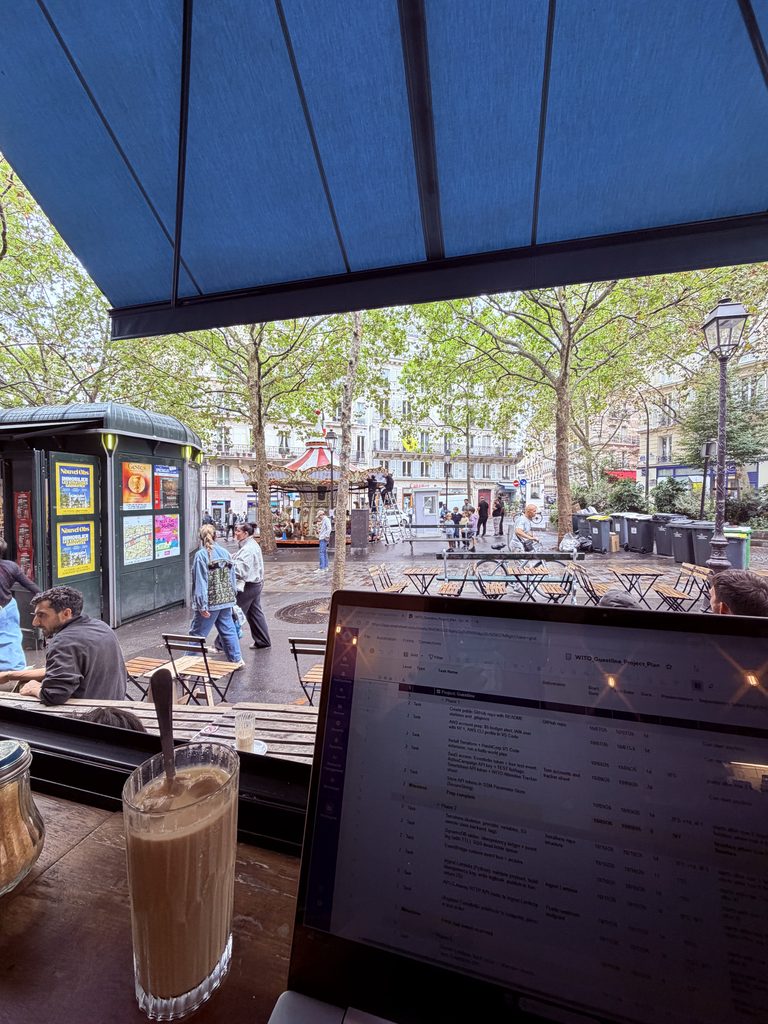
My rose-colored glasses are officially off. Somehow, that’s made my relationship with Paris more interesting, not less.
I’ll still romanticize this city shamelessly. I’ll walk along the Seine, eat too many pastries, get lost in bookstores, dress up for dinner, and sit in cafés pretending I live there. Now I’ll also notice the collection trucks, the bins, the cardboard, and the quiet machinery of Paris waste management running beneath all that romance.
Instead of looking away, I want to understand how it could work better. Loving Paris blindly was easy. Loving it with my eyes open feels like a deeper commitment, the kind that makes you want to help protect what makes it extraordinary.
Have you ever had one moment change how you see a city you love? Tell me in the comments; I’d genuinely love to hear it.